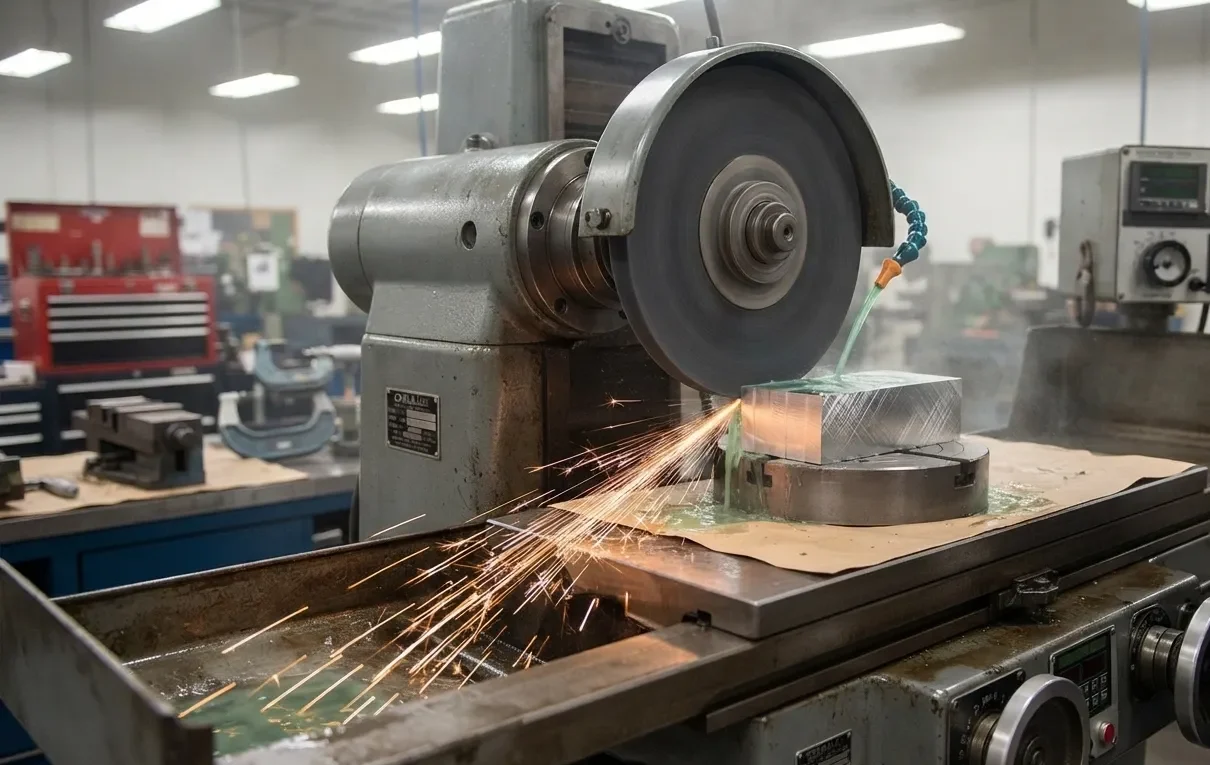
Restore flatness and finish with surface grinding services in Melbourne for replacement parts and precision components—request an assessment.
Surface grinding services restore controlled flatness and surface finish to metal components requiring accurate mating or contact faces. For manufacturers facing wear, poor fit or missing replacement parts, the right starting point is an assessment of the component, material and required finish.
What Do Surface Grinding Services Achieve?
Surface grinding removes small amounts of material from a flat face using an abrasive wheel. It is suited to components whose performance depends on an even surface, controlled thickness or reliable contact with another part. The process is not a universal cure: tolerances, hardness, distortion, prior damage and available machining allowance must be checked before work begins.
At Semtool Engineering, surface and cylindrical grinding form part of a wider machining and part-replacement capability. This matters when a worn component needs more than a cosmetic finish. Grinding may need to be coordinated with turning, milling, measurement or reverse engineering to produce a usable result.
When Is Surface Grinding the Right Process?
A manufacturability review should confirm whether grinding can recover the component or whether a replacement should be produced. Useful project information includes the mating function, critical dimensions, material, quantity and condition of the existing part.
- Flat mating faces: controlled contact can support more consistent assembly where uneven wear or machining marks have affected fit.
- Thickness control: measured stock removal can help bring a component towards its specified finished dimension.
- Replacement parts: a sample component may support reverse engineering and part replacement when usable drawings are unavailable.
- Machined assemblies: grinding can complement CNC or conventional machining where selected faces require a finer finish.
- Repair decisions: inspection can identify whether damage, distortion or insufficient material makes recovery impractical.
Information to Include With a Grinding Enquiry
Send drawings where they exist, together with tolerance and finish requirements. If no drawing is available, provide the sample part and explain how it operates. Avoid specifying “the finest possible finish” without a functional reason; unnecessary precision can add cost without improving performance.
Semtool Engineering also provides CNC and conventional machining, welding, machine design, automation and jigs and fixtures. That broader capability supports enquiries involving obsolete or damaged components rather than grinding in isolation.
Grinding work should also be planned around appropriate guarding, dust control and safe machine operation. Refer to Safe Work Australia’s guidance on machinery for general workplace responsibilities.
For repeat components, include batch quantity and inspection expectations in the enquiry. A one-off repair and a recurring production requirement may need different setup, measurement and documentation. Stating the commercial need helps the workshop recommend an efficient manufacturing route.
Request a Practical Grinding Assessment
Do not lose production time to an assumed repair method. Contact Semtool Engineering with the component, drawing, quantity and operating problem. The team can assess whether surface grinding, additional machining or replacement manufacture is the more practical route and provide a project-specific quotation.